SNAP: Low-Latency Test-Time Adaptation with Sparse Updates
Oct 1, 2025· ,,,,·
1 min read
,,,,·
1 min read
Hyeongheon Cha
Dong Min Kim
Hye Won Chung
Taesik Gong
Sung-Ju Lee
Position
First author project in KAIST Mobile Intelligence & Interaction Lab
Project Goals & Works
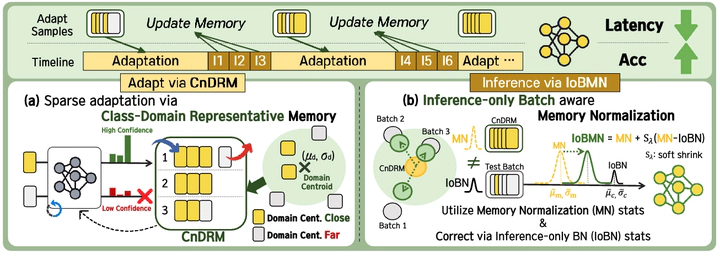
- Designed SNAP, a sparse Test-Time Adaptation (TTA) framework for latency-sensitive edge applications.
- Proposed Class and Domain Representative Memory (CnDRM) to select a compact and informative subset of target samples for adaptation.
- Proposed Inference-only Batch-aware Memory Normalization (IoBMN) to align normalization statistics at inference time with minimal overhead.
- Integrated SNAP with five state-of-the-art TTA methods and validated consistent speedups with limited accuracy loss.
Key Results
- Reduced adaptation latency by up to 93.12% compared with baseline TTA pipelines.
- Maintained competitive performance with less than 3.3% accuracy drop across adaptation rates from 1% to 50%.
- Demonstrated strong practicality for resource-constrained, real-time on-device inference scenarios.